Oh boy, you know there is something deeply rotten when business tycoons get involved in politics, especially when their ability to build fortunes depends on one’s close relationship with an authoritarian regime.
Taiwan has had its share of ultra-rich entrepreneurs who, for the sake of their business interests, have willingly cozied up to the Chinese Communist Party (CCP) and chosen to look the other way when it comes to, say, the Chinese government’s human rights abuses. Some individuals, such as Want Want China Times Group chairman Tsai Eng-meng (蔡衍明), are notorious for putting their business interests in China before trivial things like freedom of information, and it is no surprise that when the Yilan native sought to acquire Next Media’s Taiwan operations (including Apple Daily) in 2012, media watchdogs and civil society mobilized to ensure that the deal was properly scrutinized by the government.
Mr. Tsai’s efforts were frustrated, but despite his many faults — editorial pressure on his reporters, self-censorship on sensitive issues in China, bullying behavior — he rarely, if ever, acted as if he were anything other than as a businessman.
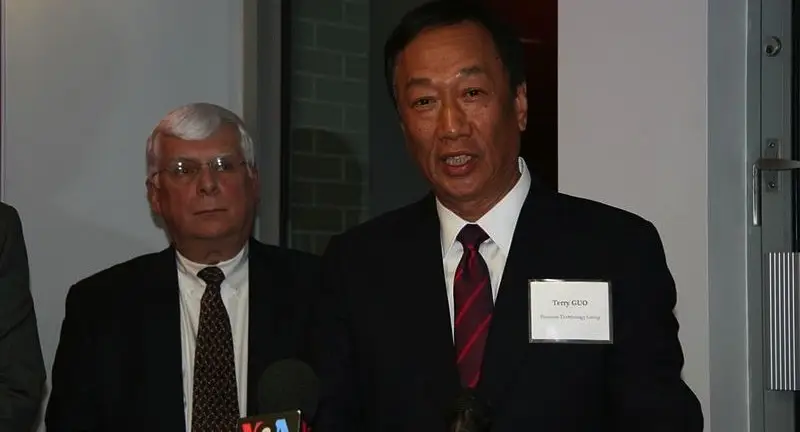
Not so much Terry Gou (郭台銘), chairman of Hon Hai Precision Technology Co, whose tremendous successes as a businessman seem to have cultivated a distorted view of his position within society and influence on government policy. Always outspoken, Gou made headlines during the Sunflower Movement’s occupation of the Legislative Yuan by offering to mediate between the activists and the government. Needless to say, many skeptics wondered how a businessman who runs an electronics contract manufacturing empire could qualify to intervene in stalled negotiations between the government and civil society at a time when the nation was facing its most serious constitutional crisis in more than a decade. Others could have pointed out that a man with such connections with the Chinese government had no place intervening in a controversy that was directly related to China’s growing influence on Taiwan’s economy and society.
The occupation has ended, but Gou is far from done with the activists. In remarks earlier this week, the 63-year-old vented his frustrations with social movements and took a rather unusual shot at democracy itself. “Social movements have let talent go to waste and wasted the nation’s resources,” he said, presumably in reference to the deployment of a large police force to counter protesters and ensure security at government institutions. Turning to needed reforms in Taiwan’s business sector, Gou then added that “democracy does not put food on the table” or contribute to GDP growth.
Gou seemed to be saying that democracy, and groups like the Sunflower Movement that fight on its behalf, tend to get in the way of economic growth and the further enrichment of people like him (his personal net worth was estimated by Forbes magazine in 2013 to have reached US$5.8 billion, making him the world’s 244th wealthiest individual). The underlying message in such a statement is that authoritarianism, such as that seen in China, is more efficient.
Interestingly, Gou’s outburst occurred as the National Communications Commission (NCC) signaled that it might take more time before it can approve his bid to operate a 4G venture in Taiwan using equipment (namely transmission towers) from China’s Huawei Technologies.
The Chinese telecommunications firm has been the object of controversy overseas, predominantly because of its ties with the People’s Liberation Army (PLA). Governments in the U.S., the U.K., Canada and Australia have enforced a ban on using equipment from Huawei and have cited security fears for that decision. Last year, Tsai Der-sheng (蔡得勝), the outspoken head of Taiwan’s National Security Bureau who resigned this week for “personal reasons,” warned against the use of Huawei technology by government agencies. The spymaster emphasized at the time that China could “very easily” acquire confidential information with Huawei products, possibly via “backdoors.” (The Chinese firm denies the validity of those claims and argues that it is being prevented access to foreign markets for political reasons in a war that has been waged for several years.)
Facing potential hurdles as a result of NCC scrutiny, Gou has threatened to stop paying his taxes if a decision is not made within a week. In subsequent comments, he also appeared to blame civil society, the media, and academics for pressuring the NCC, through their calls for greater government accountability, into making a serious evaluation of his 4G venture. In a not-too-subtle threat, Gou said that the activists “will pay for this.” He did not explain what this implied.
With his remarks, Gou the businessman was not only dictating how regulatory agencies should conduct their work, he was also arrogating upon himself powers that reside with the courts and law enforcement authorities. It is not his prerogative to decide whether social activists should “pay” for making the lives of government officials and heads of large corporations more difficult by demanding transparency and accountability — the building blocks of the democracy that Gou seems to regard as an unnecessary hassle.
If anything, Gou’s behavior is as a reminder that powerful businessmen and -women with lucrative operations in China can be just as effective as the Chinese government in pressuring Taipei to accelerate the process of liberalization across the Taiwan Strait. It is also a sign that people like Gou assume that their position as highly successful corporate leaders should earn them the unwavering respect of the government and the public alike, and the permission to involve themselves in matters that are, or should be, well outside their remit.
There was a time when Gou would have gotten away with his remarks on civil society and democracy. But the extraordinary awakening that the Sunflower Movement has sparked within Taiwanese society is such that Gou will be called to account for denigrating the open society that made it possible for him to build his empire — at least until he moved most of his operations to China. Already, his flash of anger has been met with severe criticism and ridicule by Netizens and academics.
Another possible explanation for Gou’s outlandish remarks, which he must have known would not be warmly received by Taiwanese, is that his audience wasn’t in Taiwan, but rather in China. After all, his attack on democracy and his depiction of the media and social groups as destabilizing forces that hamper economic development had the ring of Beijing’s propaganda to them. Gou may have intended his remarks to serve as a channel for Chinese pressure on the NCC and other government agencies (including those involved in national security) to allow Huawei technology into Taiwan.
We can only speculate about the pressure that Gou may also have received from the CCP, which could cause tremendous difficulties for his Foxconn operations in China should it decide to act on the many reports of suicides in the workforce, harsh working conditions, and environmental violations at its factories. This would not be the first time that Beijing used blackmail against Taiwanese firms for political objectives.
Gou’s frustration with Taiwan’s pro-democracy activists presumably stems from their efforts to ensure that the unhealthy conditions that are permitted at factories across authoritarian China and which make it possible for businessmen like him to make fortunes could never be replicated here in democratic Taiwan. Above all, civil society has mobilized to defend the liberties and rules of government accountability that indeed make the lives of officials and entrepreneurs more difficult, especially when the latter’s actions are seen to compromise public freedoms and liberties. As the activists have made amply clear through their actions, there is a lot more to life than GDP growth and putting food on the table.