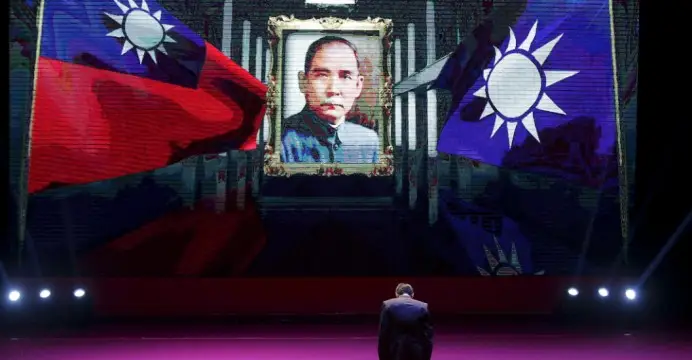
His portrait is in every public building in Taiwan, the stern look above the gray mustache signaling both vision and undoubted ruthlessness. The man is Sun Yat-sen (孫中山), the “founding father” of the Republic of China (ROC). Now legislators from the Democratic Progressive Party (DPP), which for the first time in Taiwan’s history secured a majority of seats in parliament in the Jan. 16 elections, want those portraits to be removed. As expected, the plan has sparked consternation within the Chinese Nationalist Party (KMT), which has described it as an attempt to “destroy” the ROC and fuel “ethnic divisions” in Taiwan.
The proposal, initiated by DPP Legislator Gao Jyh-peng (高志鵬), wants the requirement that Sun’s portraits be installed in every public building be dropped.
From an historical perspective, Gao certainly has a point, as Taiwan was part of the Japanese empire when Sun founded the ROC, which only transplanted itself on Taiwan after the end of World War II and the KMT’s defeat in the Civil War.
Far more relevant, however, is the symbol of Sun as a reminder of one-party rule and authoritarianism in China (which since 1949 has been taken over by Mao Zedong), which Gao has also highlighted as the rationale behind his efforts. To this we should add the implied adulation of any individual as a “father” (there are no “mothers” in the history of the ROC) of the nation. Indicatively, as in the Legislative Yuan, where the proposal will surely be heatedly debated, Sun’s portrait — before which legislators often bow — is placed in front of the Nationalist flag, which suggests the precedence of the leader, who sits atop the nation, something that isn’t seen anywhere else in democratic countries. In those countries, the flag serves as the only symbol of statehood. (For example, you will not find portraits of Thomas Jefferson, Benjamin Franklin and George Washington on equal or superior footing with the American flag inside U.S. government buildings.) The flag is the unifying symbol, the greatest common denominator, because no man (or woman) can be said to have created a nation single-handedly (not to mention that most founding fathers are controversial figures, as was Sun, a womanizing anti-hero whose beliefs in democracy were, shall we say, rather self-serving).
The KMT’s response, with its accusations that the DPP is trying to cause “ethnic tensions,” is preposterous. Recent developments in Taiwan have made it clear that ethnicity is no longer (if it ever was) at the heart of political differences here; whatever divide there is is over the values and ideals that define this nation. Therefore, it would be perfectly understandable for a “Mainlander” KMT supporter and proud ROC citizen to also have a problem with Sun seemingly sitting, strongman-like, atop the nation. (One of the first things that the new Justin Trudeau Liberal government did after coming back to power last year was to remove the picture of the British Queen at the entrance to the Department of Foreign Affairs building in Ottawa; nobody, not even the Conservatives who put it up during their years in power, accused the Canadian Liberals of sowing “ethnic discord” or trying to destroy Canada.)
The essential here isn’t to remove all portraits of Sun across the nation, or to confine him to a dusty backroom or graveyard; just that they should not be placed so prominently — before the flag, and before the nation — as they are at the moment.
Despite the validity of Gao’s proposal (and similar ones were made before), the timing isn’t ideal. Much more pressing matters that will directly affect the wellbeing of the people in Taiwan ought to be addressed in the new legislature. Whether Sun continues to stare down at government officials or remains the object of Nazi-style salutes isn’t one of those. Moreover, by making it this so soon after the DPP victory in the January elections, the proposal smacks of triumphalism. Not only does this go against what president-elect Tsai Ing-wen (蔡英文) has sought to prioritize, it empowers the more radical elements within the KMT who will seize every opportunity to attack the DPP, while weakening the more moderate voices in the party.
(Updated 2016.02.29: 09:48)
3 comments
Hong-Cin Liou has a point; more than one thing can be discussed at a time, and excuses can always be made for not confronting an issue. But it is nevertheless “bad optics”. Consider – to whom is it important? I bet your average kid at school doesn’t care, and is more worried about the constant testing he is subjected to (or whether he gets caught playing with his iphone when he is meant to be sweeping the stairwells at break time).
The only people to whom this is important are political fanatics who get their kicks from worshiping the right icons and symbols and not the wrong ones. What’s next – removing Sun from the NT$100 bill? How much time and money are we going to waste on doing this? Again most people aren’t paying attention to what the NT$100 bill looks like; they are thinking about what they can buy with it. It’s only the political fanatics who take icons and symbols seriously because they’ve got nothing better to do.
Yes you are right about democratic countries not having their founding father above the national flag. Growing up in America, we always seen George Washington and the foundating fathers portraits in museum and history books.
“It’s only the political fanatics who take icons and symbols seriously because they’ve got nothing better to do.” Agreed, so they should be removed so the rest of us don’t waste time paying false idolatry to the meaningless symbols of another country.
Comments are closed to new replies.