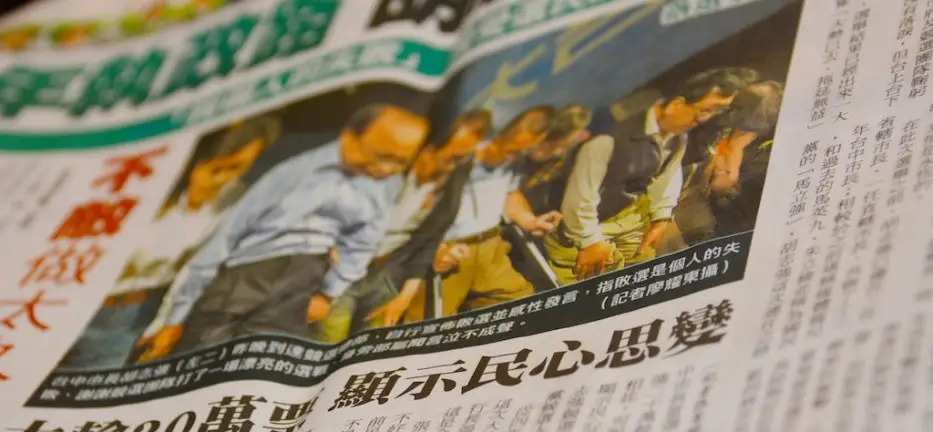
Once again today, Taiwanese media exhibited the kind of politicization and flexibility with the facts that time and again have served to undermine the credibility of the fourth estate with news consumers here and abroad. As the elections approach, those practices will likely become more frequent and increase the great amount of noise that we must already sift through as we try to make sense of political developments in this critical period in the nation’s history.
Today’s exhibit is an article in the Chinese-language United Daily News about a conference at the Atlantic Council on Wednesday. As is often the case with Taiwan’s media, the problem isn’t the article itself, but rather the headline that was given it, which in most instances is the only part of an article that has “legs.” In other words, what becomes “news” is what the headline says, and this alone determines whether other media will replicate the news or follow up with their own articles.
This is what happened today with the UDN article, which was headlined 《美智庫學者:下任台灣總統 須接受九二共識》, or “American think tank: The next president must accept the ‘1992 consensus.’” The problem with this headline is that nowhere in the article does the American academic in question — Dr. Bonnie Glaser of the Center for Strategic and International Studies, whose comments during the Q&A are the basis for the article — make such a statement.
It would be tempting to blame the reporter for the mistake, and they often are. But in this case, doing so would be invidious, as Alex Lai (賴昭穎), the Washington correspondent for UDN, got it right. Twice in the article, the author makes it clear that Dr. Glaser is speculating on what Chinese President Xi Jinping (習近平) is likely to say during his visit to the U.S. The report says: 『葛來儀表示,中方沒提出台灣問題才會讓她訝異,她推測習近平要傳達的訊息會是美國在確保兩岸穩定上扮演更積極的角色;而為了兩岸穩定,下任台灣總統必須接受九二共識,更重要的是一個中國。不過,兩人討論台灣問題的時間應該不會太長。』From the original transcript: “… I would guess that Xi Jinping’s message will be that the United States should try to play a more proactive role to ensure that cross-strait stability exists, and in order to have cross-strait stability, that there must be an acceptance by Taiwan’s next president of the 1992 Consensus, and more importantly, One China, and that the US should play a role in ensuring that that happens.”
In other words, this is not Glaser saying that the next Taiwanese president should recognize the “1992 consensus,” but what Xi might emphasize.
I have been a journalist long enough to know that beat reporters rarely, if ever, write the headlines that will accompany their article. We can therefore assume that the editors in Taipei did so. Given the strict deadlines with which editors, copy editors, page layers, and designers must deal with, it’s also very unlikely that the editors had time to go through the original English transcript. Consequently, it is very likely that the headline was based on the Chinese-language article provided by the journalist. In other words, we cannot blame poor English skills or mistranslation. The Chinese text clearly states that Glaser is guessing what Mr. Xi will likely tell his American interlocutors during his visit. It is therefore possible that the headline was deliberately written with the intent to mislead and to benefit the blue camp, within which the UDN is comfortably installed.
Thus a false piece of information — “well known U.S. academic says the next Taiwanese president [i.e., presumably Tsai Ing-wen] will have to recognize the ‘1992 consensus’” — has become news in Taiwan, regardless of what the article actually says. True to form, no sooner had the article appeared than other Chinese-language media in Taiwan (e.g., Storm Media), in their rush to beat others to the story, were reporting that an American academic had said that the next president must recognize the “1992 consensus” (to which Storm Media added “one China”). Nobody sought corroboration or bothered to check the original transcript.
Some of them, including Newtalk, have since fixed their headline. UDNchanged it late in the evening of Sept. 11.
By then, some journalists had already used the wrong information to ask the Chinese Nationalist Party’s (KMT) presidential candidate, Hung Hsiu-chu (洪秀柱), what she thought about the claim by an American academic (Glaser) that the next president should recognize the “1992 consensus.” “It’s common sense,” Hung, a strong advocate of the “1992 consensus,” replied, echoing Beijing’s stance on the matter.
The damage is done. Even if the headlines are subsequently corrected, and even if the articles were retracted or a correction issued, the initial piece of news will have taken flight, and fiction will have become reality, causing headaches for the DPP, which denies the existence of the so-called consensus, and for Dr. Glaser, to whom this is not the first time such a thing has happened.
(Updated 2015.09.11 11:29pm.)
7 comments
Maybe you could send your article to Glaser!
She has seen it. We’ve been in contact.
At 0:40 of the video (https://www.youtube.com/watch?v=xTqxmGb5npY), the person making the introduction already made a disclaimer that this seminar is but the first one of a Three-Part Series is sponsored by TECRO駐美國台北經濟文化代表處.
I suspect that the campaign is made to coincide with the soon-to-happen Obama-Xi summit. During which time, there will be plenty of opportunity to manufacture an impression that US is aligned with China on the Taiwan issue.
At 0:40 of the video (https://www.youtube.com/watch?v=xTqxmGb5npY), the person making the introduction already made a disclaimer that this seminar is but the first one of a Three-Part Series is sponsored by TECRO駐美國台北經濟文化代表處.
I suspect that the campaign is made to coincide with the soon-to-happen Obama-Xi summit. During which time, there will be plenty of opportunity to manufacture an impression that US is aligned with China on the Taiwan issue.
Well… as far as my understand… Medias did it on purpose. About 3-5 years ago there were more than one famous reporters leave their companies to express their feeling about editors modify their articles at will (And changing titles are the most common no mater now and then)… Reporter who refused to accept that leaved. And some of them goes further for their own benefit.
In fact, more than one ex-reporters wrote about it in their blogs complaining it. And itself became news.
The following address leads to a blog of ex-reporter 黃哲斌 who once served in 中國時報:
第一次買新聞就上手
http://puppydad.blogspot.tw/
Well… as far as my understand… Medias did it on purpose. About 3-5 years ago there were more than one famous reporters leave their companies to express their feeling about editors modify their articles at will (And changing titles are the most common no mater now and then)… Reporter who refused to accept that leaved. And some of them goes further for their own benefit.
In fact, more than one ex-reporters wrote about it in their blogs complaining it. And itself became news.
The following address leads to a blog of ex-reporter 黃哲斌 who once served in 中國時報:
第一次買新聞就上手
http://puppydad.blogspot.tw/
sorry… instead of “medias did it on purpose”, I should rewrite it as “medias did it very likely on purpose “
Comments are closed to new replies.