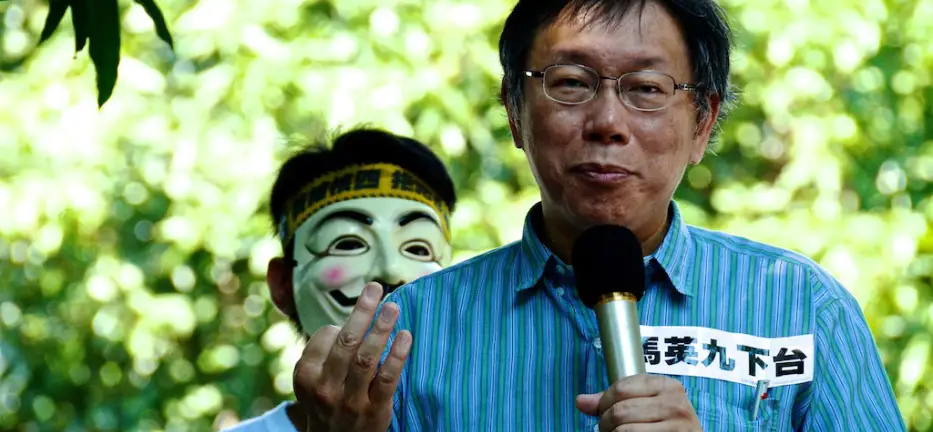
On many occasions since the members of the Sunflower Movement voluntarily exited the Legislative Yuan after a more than three-week occupation in April 2014, I have found myself correcting the perception among a number of foreign journalists and at academic conferences overseas that the dramatic events in the spring constituted a revolution. Though the term “Sunflower Revolution” was repeatedly used, it was a misnomer: It was never the intention of the Sunflowers to overthrow the system or to replace it with another. Rather, the sole objective was reform of existing institutions. Therefore, notwithstanding the “extreme” nature of their actions, the Sunflowers overwhelmingly agreed that the prevailing political system should continue to exist, though they wanted to see its many flaws remedied, and unaccounted officials expunged.
We still don’t know to what extent the Sunflower Movement succeeded in achieving its goals. What is clear is that governments can rarely implement in the whole the maximalist requests of civil society; after all, politics is the art of compromise — at least in democratic societies. The controversial services trade agreement that sparked the occupation remains stalled, and an oversight mechanism for future cross-strait negotiations, one of the conditions set by the activists before they vacated the legislature, is under consideration.
There were other less easily quantifiable successes. Despite official claims to the contrary, the Ma administration’s reputation suffered a terrible blow. The drama re-energized civic activism, bringing political awareness among the population to levels unseen in years, and generated substantial interest overseas by making Taiwan exciting and newsworthy. Finally, the occupation undoubtedly had an impact on the Nov. 29 “nine-in-one” local elections, in which the ruling Chinese Nationalist Party (KMT) was roundly defeated.
As I argued in a commentary a few months ago, the next step for the Sunflowers and the young activists the movement inspired is for themselves to enter politics and work from the inside. Since then, it has been encouraging to see a number of them choose to do so. Some of them ran in the Nov. 29 elections, while others started their own party or decided to join an existing political party — in almost every case the opposition Democratic Progressive Party (DPP), a more natural ally, given its ideology, than the KMT.
A few weeks ago I ran into a young Taiwanese man who I knew had been actively involved in Ko Wen-je’s (柯文哲) campaign for Taipei mayor. Ko, who ran as an independent, easily defeated the KMT’s Sean Lien (連勝文), who besides running a terribly incompetent campaign stood for everything that in the eyes of the population was wrong with the system. I asked him why he had decided not to join the Ko administration and had instead rejoined an educational foundation.
His response was very interesting. While he was delighted with Ko’s election, he didn’t think that the surgeon’s populist style (his words, not mine) was the right thing for Taiwan as a whole. In other words, Ko appeared at the right place at the right time, but his model should not — could not — be emulated elsewhere in Taiwan.
The young man may or may not be right, though I tend to sympathize with his sentiment. It is difficult to conceive of politics being overtaken by mavericks with little or no political experience to speak of. Ko, and the fact that he was elected (in Taipei of all places), is an aberration.
But what an aberration this has turned out to be! Despite his social awkwardness and unusual leadership style, Ko has already transformed the face of politics in the capital. In fact his awkwardness and unusual style are the very reason why Ko has been able to do the necessary to turn the situation around. By dispensing with the usual platitudes and courteousness, Ko has declared war on corrupt officials and powerful conglomerates whom his predecessors either feared or whose unethical — and perhaps illegal — activities were possibly facilitated by the administration.
In many ways, Ko is the embodiment of society’s discontent with the status quo. He is both the symptom of and the solution to everything that is wrong with the system. His is indeed a revolution in governance. Ko’s ability to transform politics in the capital is contingent on his decision to dispense with protocol and to surround himself with enablers who are willing and empowered to make the jump with him. (This is easier said than done, as Ko has already stepped on very powerful toes.) The fact that he doesn’t belong to any political party is also a major factor in this, and something that we should keep in mind as we look to 2016 and beyond.
Elsewhere, the progress has not, sadly, been as promising. The two main political parties are the system, and despite efforts at reform (among other things by hiring young people), dinosaurs on both sides are doing everything in their power to prevent new voices from changing the score. The status quo officials are threatened, and rather than adapt, they clamp down on the new employees, engaging in behind-the-scenes political machinations to damage the youths’ reputation, prevent their ability to climb in the ranks, or simply to nip their ambitions in the bud. As a result, many of the new hires have grown completely disillusioned with politics; some have already quit, others are on the brink of doing so.
Six months in, and the young idealists who entered politics to improve their country are embittered, their aspirations poisoned…
Eric Chu (朱立倫), who recently assumed chairmanship of the KMT, and DPP chairperson Tsai Ing-wen (蔡英文) may have the best intentions in the world, and may be truly committed to reform. Unfortunately, they are held hostage by extraordinary forces that militate against change. Both leaders have been forced to compromise in their appointments in order to appease factions within their parties, which while securing stability in the short term, also dilutes their ability to transform politics. The more the dinosaurs succeed in elbowing out the new blood, the more difficult it will be for Tsai and Chu to rejuvenate their institutions, which for all intents and purposes have become little more than machines meant to do one or two things: winning elections and personal enrichment.
Huang Kuo-chang (黃國昌) of Academia Sinica, who has been very active in social movements, was absolutely right when he said a little while ago that for the DPP to regain the trust of the public, it would first have to “fire a lot of its people.” Needless to say, his remarks earned him no small amount of opprobrium among senior members of the green camp, who may have recognized themselves among those who deserve to get axed. The problem for Tsai is that if she were to act on Huang’s sound recommendation and throw the dead wood out — and there is plenty of it, as the Dec. 25 elections showed us in Tainan — she would face a mutiny.
The same holds for Chu should he decide to address, as he has promised, the party’s illegal assets or target “black gold” politics and corruption within the KMT.
Ceteris paribus, under the prevailing system the party with the most money and whose influence extends the farthest within society will continue to have the advantage.
Meanwhile, in a most unfortunate turn of events, activists and professors who refused to join existing parties and formed their own are now at each other’s throats and splitting into factions, an outcome that needless to say has caused rejoicing in both the KMT and the DPP, especially among the dinosaurs who have had no compunction in devouring their own youths.
The system itself has become rotten, and those who benefit from it are actively working to ensure that the rot continues. It may be good for them, but there is no doubt that it is bad for Taiwan’s long-term prospects. Maybe the young man was wrong. Maybe the Ko model, a clean break with the past and total disregard for protocol, should be extended nationwide. Whether such change can emerge from within the system, or will need to be imposed from the outside, is anyone’s guess. Regardless, that would be a revolution in the full sense of the word!
11 comments
Thx for the good article.
Ko is one of his own kind and I think it’d be impossible for his pattern to spread nationwise.
In fact, I wonder how long Ko can last. Not in the sense of how long his will power can last (no doubt in that regard), but how long can those dark powers stand being crashed without coming out of a plan to make him disappear.
At this moment, just one month into his mayorship, he already pushed companies of extreme rich to the edge. In the future, he will start to crash gansters and other dark powers. When they all are pushed to a point in such a short time (i.e., no time for the new balance to establish), all of those powers (money + violance) will most likely come toghter to deal with their common enemy.
“Despite his social awkwardness and unusual leadership style…”
… which is completely irrelevant. The mayor of a major city is there to make sure public infrastructure gets fixed properly and on time, and to ensure funds from taxation are not wasted on frivolous nonsense. A mayor is there to attend to a limited range of important things, not to make silly dances and smiley faces – that’s what clowns are for.
In fact, Echo Taiwan, Ko has now received a threatening phone call, putting him on notice for going against the wealthy:
http://udn.com/news/story/6655/673511
With respect to the first comment, I do not agree that Ko-P is necessarily a unique case. If we look at what got him where he is now, it all starts and ends with the ability of people in his camp to use social media, and the Internet more generally, to their advantage.
I have talked with a number of young Taiwanese, and what I find very interesting is they acknowledge that at some point the social effect of the Ko campaign was self-perpetuating, as it became “cool” to like whatever the Ko team was doing or saying. People figured that other people in their social circles liked or shared these things, and liked or shared them further, too. In this way, “liking” the Ko campaign became a matter of identification for many young people. Of course, the fact that Lien S. made for such a handy image of everything that is perceived as wrong in Taiwan’s society, only helped simplifying the cause.
What I find more interesting, still, is why it was not 馮光遠 who found the support of most young people, despite his being closer to the Sunflowers’ ideology and movement than Ko-P. Perhaps media-savvy can help explain Ko’s success. And if that’s the case, there may be other, similar outsider figures out there and the establishment should be genuinely concerned. More of that, please!
Thanks. The dead threat Ko received is not a surprise to me. I believe he will get more, and the real blow will come without threat. I just don’t believe that any power so big, so deep, will just sit there watching all their long time efforts vanish without makeing a move. Let along this is not just one big power but several; and this is not just the rich but the gansters. So many people involved, and their common problem is just one person, the solution is simply too easy not to take.
I do agree that there’s a big social wave behind Ko, and that’s the background he rises from. But in my opinion he takes the wave into next level. At least, among other things, he turned the social movement into a political reality.
I don’t see (well my vision is limited) any other people in the Sunflower movement or in any other group is capable of doing that. Look at where the so-called “spiritual leader” of non-partician forces, 林義雄, is now. Look at how leaders of Sunflower movements split their small forces even before they are able to make a practical stand in the political field. Ko convinced people of different political stances and combined them into a huge force, when none other in the social movement can convince even people of their own, but very capable of splitting their already small force into even smaller ones.
IMO, Ko’s gaining media spot light is not that it just happened, but a well calculated move from Ko. He must be very aware what media likes to report and what readers like to hear, so since the very beginning he went on the media to make good use of it. Pan-green has been complaining the unfairness of the media as one of their major disadvantages. For decades, they couldn’t figure out a way to fight this. Ko, on the other hand, single-handily turned the media into his advantage in one year, without spending a nickle. It seems to me that he simply knows better and see deeper. The way I see it is that, he actually controls and plays the media.
It turns out that the Chthonic leader, Freddy, is the presumed leader of the new party, New Power Party (時代力量):
http://chthonictw.tumblr.com/post/109190624668/chthonic-members-form-a-new-political-party-in
Thank you for the interesting news regarding Freddy Lim forming a new party! That’s just brilliant!
I’d like to add only three things: First, the way I see it Ko-P wasn’t part of the Sunflower movement at any point, and I don’t think he claims to have been. Second, while his campaign made excellent news of new (social) media, this is not were the green camp has been structurally disadvantaged. I don’t think Ko-P actually played the (traditional) media, but rather the other way round: They caught up with increasingly popular trends for their own ends. Third, Ko-P was not on the political radar before his decision to join the mayoral elections (neither was he well-known), and the “Ko consensus” built up over quite some time, which is why I reasoned that this could happen anytime. It takes a favorable combination of conditions and right person at the right time.
>>> regarding Freddy Lim forming a new party!
There is another one, Aqua Tsai:
蔡丁貴:組台獨左派政黨 監督綠中國政策
http://news.ltn.com.tw/news/politics/paper/852560
Tsai is the TIer on the extreme side. He believes in street movement and protest on the ground will gain TI more surport than persuading the voters does. He is a firm believers of splitting a force into multiple fronts is a better approach.
He claims that several TI groups give him positive response and the new party will launch when the time is right.
>>> regarding Freddy Lim forming a new party!
There is another one, Aqua Tsai:
蔡丁貴:組台獨左派政黨 監督綠中國政策
http://news.ltn.com.tw/news/politics/paper/852560
Tsai is the TIer on the extreme side. He believes in street movement and protest on the ground will gain TI more surport than persuading the voters does. He is a firm believers of splitting a force into multiple fronts is a better approach.
He claims that several TI groups give him positive response and the new party will launch when the time is right.
>>> First, the way I see it Ko-P wasn’t part of the Sunflower movement at any point, and I don’t think he claims to have been.
I don’t see any one claimes that. There is a wave and both Ko-P and the Sunflower rise on the wave.
>>> Third, Ko-P was not on the political radar before his decision to join the mayoral elections (neither was he well-known),
We probably focus on different sides of Taiwan.
>>> It takes a favorable combination of conditions and right person at the right time.
That’s basically what I said, isn’t it ?
Comments are closed to new replies.