With a glint in the eye, the China “expert” has a solution to the many challenges that are associated with China’s growing assertiveness. Not without theatricals of regret, the expert admits being resigned to the idea that we inhabit an “imperfect world.” The world is unfair. But something must be done about China to avoid some cataclysmic conflict, they say, one that would presumably involve the U.S. Concessions must therefore be made to sate the hungry beast, for “peace.” Ask them what they mean by concessions, and nine times out of ten the answer will be, Taiwan. Hand over democratic Taiwan to authoritarian China, their argument goes, and all our troubles associated with the rise of a dangerous hegemon will go away.
My point here isn’t that concessions — or appeasement, to call such proposals by their proper name — are misguided and would only encourage further Chinese expansionism. Nor shall we dwell on the fact that trading a democracy for the sake of pleasing a repressive regime would be an affront to the values that we in the “free world” purportedly stand for. What needs to be discussed is far more fundamental: Did anyone ask the 23 million Taiwanese?
What is most shocking about the so-called experts who make the case for “relinquishing” Taiwan and forcing it into China’s bosom is that many of them had never set foot in Taiwan before they began articulating such views. Others had only made sporadic visits on all-expenses-paid government junkets, which usually involve brief meetings with the president, MOFA officials, and brief trips to Kinmen or the National Palace Museum. Four, five days, and they understand Taiwan. Most therefore have had little, if any, contact with ordinary Taiwanese, let alone NGOs and members of the opposition (a not infrequent phenomenon under the current administration, which has a tendency to “forget” to put the DPP on the agenda).
And yet, despite the silo vision that such visits ensure, those same experts pretend to know what is best for Taiwanese (conversely, it could be that they don’t give a damn what Taiwanese think). Some even have enough moxie to speak on their behalf. The experts don’t know the people, their hopes, dreams, fears, but somehow they think they are qualified to propose decisions that would affect the future of 23 million people without even seeking their input. Come to think of it, not knowing the people, and therefore being unable to make an emotional connection with them, is probably a precondition for an expert’s ability to make such policy prescriptions.
Anyone who makes the effort to get to know everyday Taiwanese — small business owners, students, activists, office workers — or who has lived in their midst long enough will understand why “giving” Taiwan to China is not only a stupid idea, but a recipe for future disaster. Only someone who doesn’t know Taiwanese would expect the two societies to function in a post-unification arrangement in which Taiwanese themselves didn’t have a say (and if they have a say, unification is a highly unlikely outcome).
What these experts would do, for the sake of geopolitical stability, is deny Taiwan’s 23 million people the right to determine their future. And it is a right, not a favor to be selectively granted by the powers that be. Sadly, throughout Taiwan’s history that right has often been denied to its people. Just last week, a sweet 88-year-old lady who was dear to me passed away after a long battle with illness. She was born to a land whose fate had already been determined by others, and in which she and her people were treated as little better than second-rate citizens. She was a subject of Taiwan’s Japanese colonial masters. After World War II, the fate of her country was once again decided by others, and this time Taiwan fell into the hands of a KMT regime that visited manifold forms or repression upon its subjects, and killed countless thousands who refused to be subjects again. Taiwanese were re-colonized. In the process, they were ridiculed, beaten, and despised for their inability to speak “proper” Mandarin. They were told, despite every fiber of their body telling them otherwise, that they were Chinese, that their destiny was tied to that of the “Mainland,” which was to be retaken.
After decades of living under stifling authoritarian rule, Taiwanese won their right to chart their future. Without bloodshed, they turned their country into a democracy. They were now free to elect their rulers and to criticize government whenever it failed to meet the needs and expectations of the people. They even chose in 2008, after an eight-year hiatus, to bring back to power the very party that had repressed them over five decades.
But while the island was shedding the skins of authoritarianism, China was emerging from the dark pits of the Cultural Revolution and began focusing on building its economy, launching a process that eventually positioned China as the world’s second-largest economy. With economic power and a modernized military came influence. And Beijing did not hesitate to throw that influence around, especially on matters it regards as “core interests,” which includes Taiwan. (Needless to say, authoritarian China cares not one iota whether Taiwanese are interested in joining the Chinese family.) In response, the international community, its morale dwindling, its economies messy, has allowed Beijing to exercise that influence to unhealthy levels. When it comes to China, we’ve thrown our liberal values out the window.
Consequently, we have now arrived at a point where Taiwanese once again risk not being allowed to freely choose their destiny. Granted, they never had a completely free choice, given the Chinese military threat and the political constraints imposed on the Taiwanese externally. But as long as China was weak enough, those curtailed choices translated into the “status quo” we are all familiar with. The implication of China’s rise is that the status quo is no longer static; it is dynamic, and it is shifting in Beijing’s favor (demographics and self-identification within Taiwan are moving in the opposite direction, though).
Aware of this, Taiwanese have begun to take action. They do not want other people to make the choices that belong to them, and they seek to counter the invisible forces that are conspiring to undercut their ability to determine their future. The Sunflower Movement’s occupation of the Legislative Yuan earlier this year, or the many protests that preceded this extraordinary event throughout 2012, were all signs that something was brewing, that Taiwanese were getting increasingly uncomfortable with their situation. “You’re lucky you have a Canadian passport,” young activists would often tell me. “If China takes over, you can just leave. We’re stuck here. We have to fight. This is our country.” When their choices are limited by external forces, when Taiwan’s principal ally quietly (or not so quietly) seeks to manipulate electoral outcomes so that a legitimate alternative to the KMT faces a severe handicap, Taiwanese must make a choice between two options: surrender to forces that seek to create an inevitable (and undesirable) future, or fight. I have every reason to believe that they will fight (who wouldn’t, when the inevitable future involves being subjected anew to authoritarian rule?).
Next time foreign experts and officials presume to know what is best for the Taiwanese, or are tempted to disregard their right to choose their future for the sake of some grand, and probably naïve, quid pro quo with the Chinese, they should hold their silence and visit Taiwan one more time (or for the first time, in some cases). They should skip the usual diplomatic tour and engage real people, people who struggle daily to make a living, fresh graduates who are unable on current salaries to afford a house in the capital, farmers who stand to lose their livelihood to the forces of globalization, residents whose neighborhoods will next be razed to make room for luxury apartments that will lie vacant until wealthy Chinese are allowed to invest in real estate here. Those so-called experts should engage ordinary people and seek to understand their fears. And they should ask them whether they are willing to abandon their democracy, however flawed it might be, and join a country that has fully demonstrated its unwillingness to countenance alternatives to authoritarian rule (anyone who believes that Beijing would treat Taiwan more generously than it treats Hong Kong is deluded). Nobody but the Taiwanese has the right to “cede” Taiwan to China. They should have the freedom to choose such an outcome if this is what they want, not have it imposed on them through deals or coercion.
And rather than discard them as “violent,” “illegal” and “undemocratic” troublemakers, the experts should try to understand why the Sunflower activists did what they did earlier this year, and why they will likely take action again, as Taiwanese once again face the prospect of being squeezed by Beijing, the KMT, and their allies overseas. By regarding them as human beings capable of making rational choices about their future, by getting to know them, the experts would form an emotional bond that in turn would make it more difficult for them to dehumanize the Taiwanese.
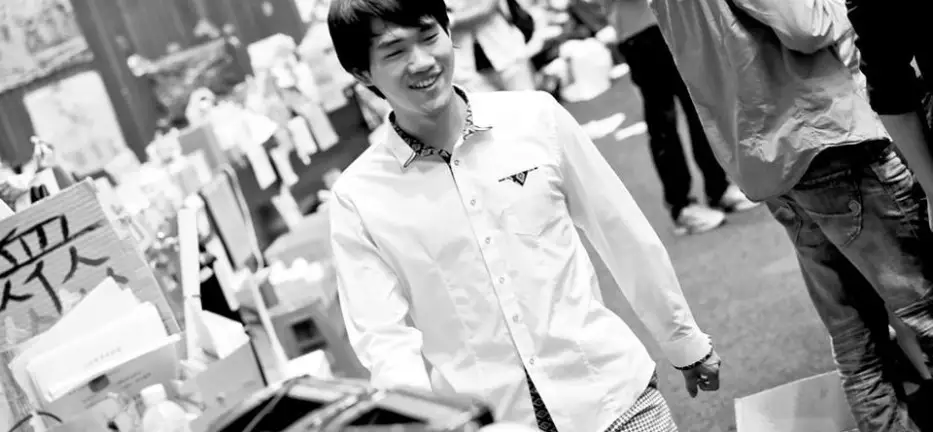
Before they propose sacrificing Taiwan, those experts should sit down with young people like Oliver Chen (陳瑞光), the bright, driven, NTU law school student who played a key role during the Sunflower occupation as one of the movement’s voices to the outside world. Chen, 26, who was now involved in the nationwide Taiwan March, died in a motorcycle accident on Tuesday. For those of us who have made the effort to get to know ordinary Taiwanese, the sense of loss at the extinguishing of so young a life, of this young, proud and idealistic Taiwanese, is overwhelming.
To all the so-called experts who believe that Taiwan is something that can be given away, that its people are mere pawns without a voice, I would say this: Before you open your mouth again, imagine yourself telling Chen that he has no free will, that his efforts to create a better world for himself and his people are doomed. Ask the dead who never had a choice. And ask the living, whose future is still being written.
In one of his last entries on his Facebook page, Chen posted a screen grab from the Korean movie Old Boy. “I have no regrets. Do you?” the English caption reads at the bottom, as a female character, clutching someone’s hand, hangs over a precipice.
Goodbye Oliver. Others will continue the battle to make sure that Taiwan’s voice is heard.
6 comments
Thanks for writing. It’s sad that Oliver Chen left us so young. His wonderful achievements will be the inspirations for us all and generations to come…
This should be mandatory reading for the US president, his security advisers and trade representatives, and the entire State Department. The US would lose every ounce of its soft power if it played any role whatever in China swallowing up Taiwan.
If history is any guide we must not underestimate the ignorance, naivety, cynicism, and outright betrayal that could result in Taiwan being ‘discarded’ by foreign powers in favour of imaginary and transient ‘concessions’ from China. Many many more nations could ally themselves with Taiwan and yet they do not, mostly out of a hope that appeasing China will bring economic benefits. That is the world we live in today. Human life is taxonomically calculated and weighed in clinical SWOT analyses against fiscal benefits and risks. Democracy is given little more than lip service and is only truly practiced in very few locations. The bigger and more wealthy the country, the more likely that its establishment and ruling elite is comprised of a ruling political duopoly that serves the illusion of choice to cover what is essentially a corporate state. Taiwanese would do well neither to put their trust entirely in any other nation, isolate themselves, or give in to fatalism.
After I spent five days in Canada (including one hour with the prime minister, two hours hockey game in the prairie, one day outing in BC), I’ve certainly become a Canada expert. And, as a Canada expert, I declare that Quebec should be returned to France. Oh, by the way, je n’parle pas français and have never talked to one single person in Quebec.
And yes, I’ve spent five days in Vienna; therefore, I am also an Austria expert. I propose that Austria be “returned” to Germany.
Heck, I am in a “giving” mode. I’ve visited Kiev for a week; thus, I am a Ukraine expert. I say, give Ukraine to Russia and we all have peace in the whole world.
Chen’s death is a horrible tragedy. We need more like him.
You are right that the desires of the people of Taiwan should matter most in this controversy. However, Taiwanese views are very diverse and complex. Furthermore, we cannot ignore the reality of the situation. The reality is that we have a large and powerful neighbor, and we cannot ignore them. We cannot bury our heads in the sand or wish away China. We cannot rely on arguments of human rights to defend us.
Despite much progress, we still live in a world governed largely by might = right. I don’t like that, I wish it wasn’t so. But wishing just isn’t enough. You say that Taiwanese are willing to fight to defend our homeland. I agree with that, I would be willing to fight should the PRC invade. However, regardless of the outcome a war would be the worst possible result for Taiwan. Lets say there is a war, and Taiwan wins. How many Taiwanese civilians would be dead? How many of our cities would be destroyed? Sure China would suffer a loss of face, and the death of many soldiers perhaps. But China’s civilian population would largely unaffected. What kind of victory would that be? Another possibly is that Taiwan would be both destroyed and conquered. Sure the world would wave their finger at naughty China. And maybe they would even pass sanctions against them. But how many years did it take the world to forget the Tiananmen massacre and start business with China again? I’m afraid the same would happen in this case.
So, Taiwan must find a way to avoid war. We can hope that the US would defend us, but who knows if they really will. And let’s be honest if the US doesn’t then nobody will.
I am proud of Taiwan’s democracy. I don’t want to see it destroyed or subsumed by the PRC. However, we cannot simply wish that China and the world will follow the abstract notions of human rights and self-determination. (The US certainly doesn’t follow those ideals 100% of the time, but only when it fits its interests.) I don’t pretend to know what the answer to this complex situation, but we need a realistic approach.
China is under the illusion that time is on their side. Taiwan can use this to its advantage. We continue to give lip-service to one China and maintain the status quo. We can still resist political integration, but not give them a pretext for war by declaring a Republic of Taiwan. I’m not so sure that time is on the PRC’s side. They face a lot of threats and challenges both domestically and externally. I believe that in time the PRC will have to reform/democratize or face destabilizing internal unrest and possible collapse.
As an American expat, I have spent a solid 26 years in Taiwan. Half of that time has been spent in the industry, interviewing the founders of Taiwan’s technology and their successors. I have been writing to promote Taiwan industry for all those years. Taiwan has proven its ability to be an independent nation and earned it. China steals that technology. Now that Taiwan shows such potential, China wants to benefit from that.
Comments are closed to new replies.